
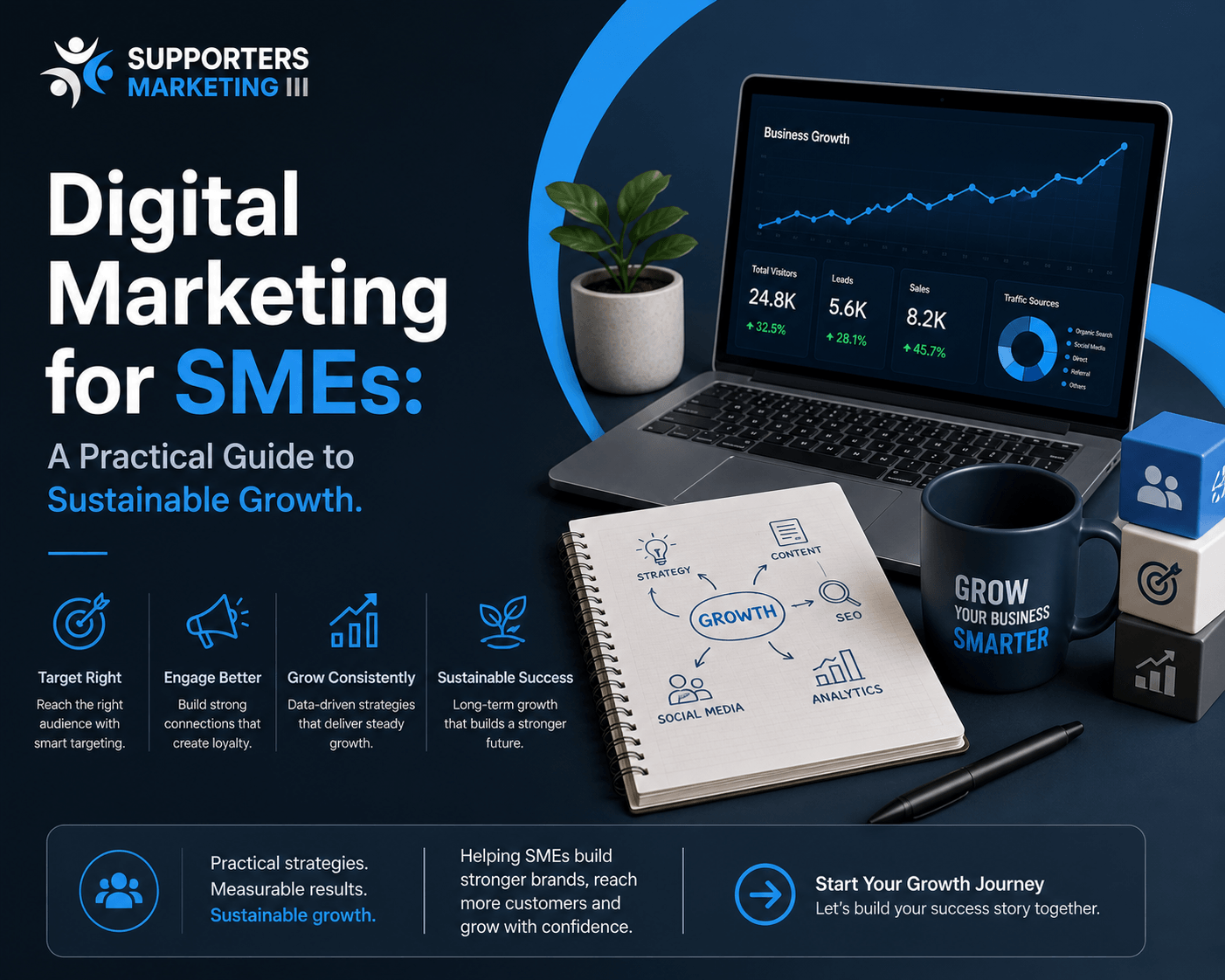
Most small and medium enterprises don’t lose customers because their product is weak. They lose customers because nobody can find them online, and when someone does find them, nothing about the experience builds enough trust to convert. That gap between “we have a good business” and “people can find and trust our good business” is exactly what digital marketing for SMEs is meant to close.
This guide walks through what actually works for resource-constrained businesses right now, not a generic list of tactics copied from enterprise marketing playbooks. If you run an SME and want a realistic, prioritized approach to growing online, this is written for you.
Quick answer: Digital marketing for SMEs works best when it follows a sequence: a fast, trustworthy website first, local and organic SEO second, then paid ads layered on top once conversion tracking is in place, with content and automation tying everything together. Businesses that skip the foundation and jump straight to ads usually pay more per lead than they should.
Why Digital Marketing Matters More for SMEs Than for Large Brands
Large brands can survive on brand recognition alone. Someone searches for a well-known company by name and finds it regardless of SEO quality. SMEs don’t have that luxury. Your buyers are searching for the problem you solve, not your business name, which means visibility has to be earned through relevance, not inherited through reputation.
This changes the entire approach. An SME’s digital marketing strategy needs to work harder per rupee or dollar spent, because there’s no brand equity cushion absorbing inefficiency. Every page, every ad, every post has to justify its existence in terms of leads or sales, not impressions.
There’s also a timing advantage that many SMEs underuse. Local and niche search terms are far less competitive than broad national or global keywords. A well-optimized SME website can outrank much larger competitors for the specific, high-intent searches that actually convert, simply because bigger companies aren’t bothering to target them.
Building the Foundation: Your Website as a Sales Asset
Before spending a single rupee on ads or chasing social media followers, the website needs to do its job. Think of it less as a digital brochure and more as your best salesperson, working around the clock, forming a first impression in about three seconds.
Speed and Core Web Vitals
Google now factors page experience signals, including Core Web Vitals, into how it ranks pages. Beyond rankings, speed directly affects conversion. A slow-loading site on mobile data (which is how most SME customers in Pakistan and similar markets browse) loses visitors before the page even finishes loading. Compress images, use a caching plugin if you’re on WordPress, and avoid bloated page builders that load unnecessary scripts.
Mobile Usability
If your analytics show more than half your traffic coming from phones, and for most SMEs that number is far higher, your site needs to be designed mobile-first, not adapted from a desktop layout afterward. Tap targets, form fields, and click-to-call buttons all need to work cleanly on a small screen.
Trust Signals
Visitors decide whether to trust an unfamiliar business within seconds. Real client testimonials, visible contact information, business registration or certification details, secure checkout badges for e-commerce, and a genuine “About” page with real people and real photos all reduce the hesitation that kills conversions. Stock photography of generic office workers does the opposite; it signals a business that doesn’t want to be seen.
SEO-Friendly Architecture
A clean site structure, logical URL naming, descriptive headings, and clear internal linking between related pages help both users and search engines understand what your business actually offers. This becomes the backbone that every SEO effort afterward builds on top of.
Search Engine Optimization: The Long-Term Growth Engine
SEO tends to be underrated by SMEs because results aren’t instant, and overrated by agencies who sell it as a magic bullet. The realistic picture: SEO is the highest-ROI long-term channel available to most SMEs, but it takes three to six months of consistent work before it compounds into predictable traffic.
Keyword Clusters, Not Isolated Keywords
Targeting one keyword per page is an outdated approach. Modern SEO rewards topical authority, meaning you build clusters of related content around a core theme. If your SME sells industrial packaging equipment, for example, you don’t just target “packaging machine Islamabad.” You build supporting content around related searches: maintenance guides, comparisons between machine types, industry-specific use cases, and buying guides. This signals to Google that your site is a genuine authority on the topic, not a page trying to rank for one phrase.
Search intent matters here more than keyword volume. A keyword like “best packaging machine for small factories” signals someone close to a buying decision, while “how does a packaging machine work” signals someone still researching. Your content strategy should map to where the buyer actually is.
On-Page and Technical SEO
On-page work includes optimized title tags, meta descriptions that genuinely describe the page (not stuffed with keywords), header structure that reflects a logical hierarchy, and content that answers the actual question a searcher has. Technical SEO covers the less visible layer: proper indexing, structured data (schema markup) so Google can understand your content in context, a clean XML sitemap, and no broken links or duplicate content issues quietly dragging rankings down.
E-E-A-T: Why It Matters for Small Businesses
Google’s quality guidelines emphasize Experience, Expertise, Authoritativeness, and Trustworthiness. For an SME, this translates into practical steps: publish content written or reviewed by people who actually understand the industry, cite real sources, show credentials or years in business where relevant, and keep information accurate and updated. Generic, thin content written purely to hit a word count works against you here, not for you.
Local SEO and Google Business Profile
For any SME serving a physical or regional market, local SEO is often the single highest-leverage activity available. An optimized Google Business Profile, complete with accurate categories, real photos, updated hours, and a steady stream of genuine reviews, frequently outperforms paid search for local intent queries like “digital marketing agency near me” or “best furniture store in Rawalpindi.” Consistency of your business name, address, and phone number across directories (known as NAP consistency) also reinforces local ranking signals.
Off-Page SEO and Backlinks
Backlinks from relevant, authoritative sources remain one of Google’s strongest ranking signals, but the approach matters. Guest contributions to industry publications, partnerships with complementary local businesses, and being featured in relevant directories or news coverage build authority sustainably. Buying links or using link farms is a shortcut that eventually costs far more than it saves, since Google’s algorithms and manual reviews are specifically designed to catch and penalize it.
Paid Advertising: Google Ads and Meta Ads
Paid advertising earns its place once your website converts well and you can track what happens after a click. Spending on ads before fixing conversion is the most common way SMEs waste marketing budget.
Google Ads for SMEs
Search campaigns work best for capturing existing demand, people actively searching for what you sell. Structure campaigns around tightly themed ad groups rather than one large group with dozens of unrelated keywords; this improves Quality Score, which directly lowers your cost per click. Performance Max campaigns can extend reach across Google’s full inventory but need clean conversion data to optimize effectively, so they work better as a second phase rather than a starting point. Display campaigns are useful for remarketing to people who’ve already visited your site, but rarely perform well for cold audiences on their own.
Bidding strategy should evolve with data volume. Manual or maximize-clicks bidding makes sense early when you don’t have enough conversion data. Once you’ve accumulated 30 to 50 conversions in a reasonable window, automated strategies like target CPA or target ROAS typically outperform manual bidding.
Meta Ads for SMEs
Facebook and Instagram ads work differently, they interrupt rather than capture intent, which means creative quality matters enormously. A campaign built around a genuinely well-shot product video or a clear, benefit-led carousel will consistently outperform one built around a generic stock-photo static image, regardless of targeting precision.
Campaign objective selection should match the actual buying stage: awareness objectives for cold audiences who’ve never heard of you, conversion objectives for warmer audiences closer to a decision, and dedicated remarketing campaigns for people who visited your site or engaged with content but didn’t convert. Remarketing audiences almost always deliver the lowest cost per acquisition because you’re re-engaging people who’ve already shown interest.
Content Marketing and Social Media
Content marketing and social media are often treated as the same activity by SMEs, but they serve different purposes. Content marketing, blog articles, guides, case studies, builds long-term organic visibility and supports SEO. Social media builds relationship and recall with an existing or growing audience, and works best as a distribution channel for that content rather than a standalone strategy.
The mistake most SMEs make is posting inconsistently without a clear purpose behind each piece. A better approach: define two or three content pillars directly tied to what your business sells, create content around genuine customer questions (support teams and sales staff are the best source of real questions), and repurpose one solid piece of content across formats, a blog article, a LinkedIn post, a short video, an email, rather than creating unrelated content for each channel separately.
WhatsApp Business, Email Marketing, and Automation
For many SME markets, WhatsApp Business has become a primary sales and support channel, often outperforming email for response rates. Automated greeting messages, quick replies for common questions, and product catalogs within WhatsApp Business reduce response time, which directly affects conversion since buyers frequently choose whichever business responds first.
Email marketing still delivers strong ROI when used correctly, not as a broadcast channel for occasional promotions, but as a structured sequence: a welcome series for new subscribers, abandoned cart recovery for e-commerce, and periodic value-driven content that keeps your business top of mind without feeling like spam.
Marketing automation ties these channels together. A basic automation setup, lead capture on the website, automatic routing to WhatsApp or email, a follow-up sequence for unconverted leads, removes the manual work that causes leads to go cold simply because nobody followed up in time.
Common Mistakes SMEs Make in Digital Marketing
A few patterns show up repeatedly across SME marketing efforts. Running ads to a slow or untrustworthy website wastes budget on traffic that was never going to convert regardless of targeting quality. Chasing follower counts or social media vanity metrics instead of tracking leads and revenue creates a false sense of progress. Treating SEO as a one-time project rather than ongoing work causes rankings gained over months to erode within weeks of neglect. And spreading a limited budget thinly across every available channel, instead of dominating one or two channels first, usually produces mediocre results everywhere rather than strong results anywhere.
A Realistic Action Plan for Growing SMEs
Start by auditing your website for speed, mobile usability, and trust signals, since everything else depends on this foundation converting well. In parallel, claim and fully optimize your Google Business Profile if you serve local customers, since this often produces visible results faster than any other channel. Build out three to five core content pieces targeting keyword clusters relevant to your highest value services and set up basic conversion tracking (Google Analytics 4 and Meta Pixel at minimum) before spending on ads.
Once tracking is confirmed working, start with a small, tightly targeted ad budget rather than a broad one, and let real data guide where you scale spend. Layer in WhatsApp Business and email automation to make sure no lead falls through the cracks. Review performance monthly against actual business metrics, leads generated, cost per lead, and revenue, not likes or impressions.
Expect early SEO signals within 60 to 90 days, meaningful organic traffic growth by month four to six, and paid campaigns to stabilize in cost efficiency within four to six weeks of consistent optimization. Businesses that follow this sequence typically see a steadier, more sustainable growth curve than those that front-load spend on ads without a proper foundation.
Key Takeaways
Digital marketing for SMEs works best as a sequence, not a scattershot of tactics: a fast, trustworthy website first, local and organic SEO next, paid advertising layered on once tracking is solid, and content and automation connecting everything together. The businesses that grow fastest are usually the ones that get the foundation right before spending on traffic, not the ones with the biggest ad budgets.
Your Questions, our answers.
What is digital marketing for SMEs? Digital marketing for SMEs refers to the practical use of online channels, SEO, social media, paid ads, email, and content, to help small and medium enterprises attract customers, generate leads, and grow revenue, typically with tighter budgets and more direct ROI accountability than large enterprise marketing.
How much should an SME budget for digital marketing? There’s no universal number, but a common practical range for actively growing SMEs is 7 to 15 percent of revenue, split between essential foundations (website, SEO, basic content) and variable spend (ads) that scales up once early channels prove profitable.
Is SEO or paid advertising better for a small business? They serve different timelines. SEO takes longer to show results but produces compounding, lower-cost traffic over time. Paid advertising produces faster results but stops the moment spend stops. Most growing SMEs benefit from starting with SEO fundamentals and adding paid ads once the website converts well.
How long does SEO take to show results for a small business? Most SMEs see early ranking movement within two to three months and meaningful traffic growth by month four to six, depending on competition level and how consistently content and technical SEO work are maintained.
Do small businesses really need a website if they’re active on social media? Yes. Social media platforms control your reach and can change algorithms or policies at any time. A website is an owned asset you control fully, and it’s typically where actual conversions and SEO-driven organic traffic happen, something social profiles can’t replace.
Conclusion
Growing an SME through digital marketing isn’t about doing everything at once. It’s about sequencing the right activities, foundation, visibility, trust, then paid acceleration, so every rupee spent builds on something solid rather than being wasted chasing traffic that was never going to convert. If you’d like a tailored digital marketing plan for your business, Supporters Marketing works with SMEs across Islamabad, Rawalpindi, and internationally to build exactly this kind of ROI-focused growth strategy. Get in touch to discuss where your business stands today and what a realistic 90-day plan could look like.

 Chat on WhatsApp